
By: Katie Murphy
For high school players in the Class of 2029, the college lacrosse recruiting process may feel far away. But rising sophomores who want to play lacrosse at the next level can begin taking important steps now to prepare.
You don’t need to have a final college list, a perfect highlight reel, or all the answers about where you want to play. What matters most at this stage is starting to build strong habits, creating the right recruiting tools, and learning where you may realistically fit as a student-athlete.
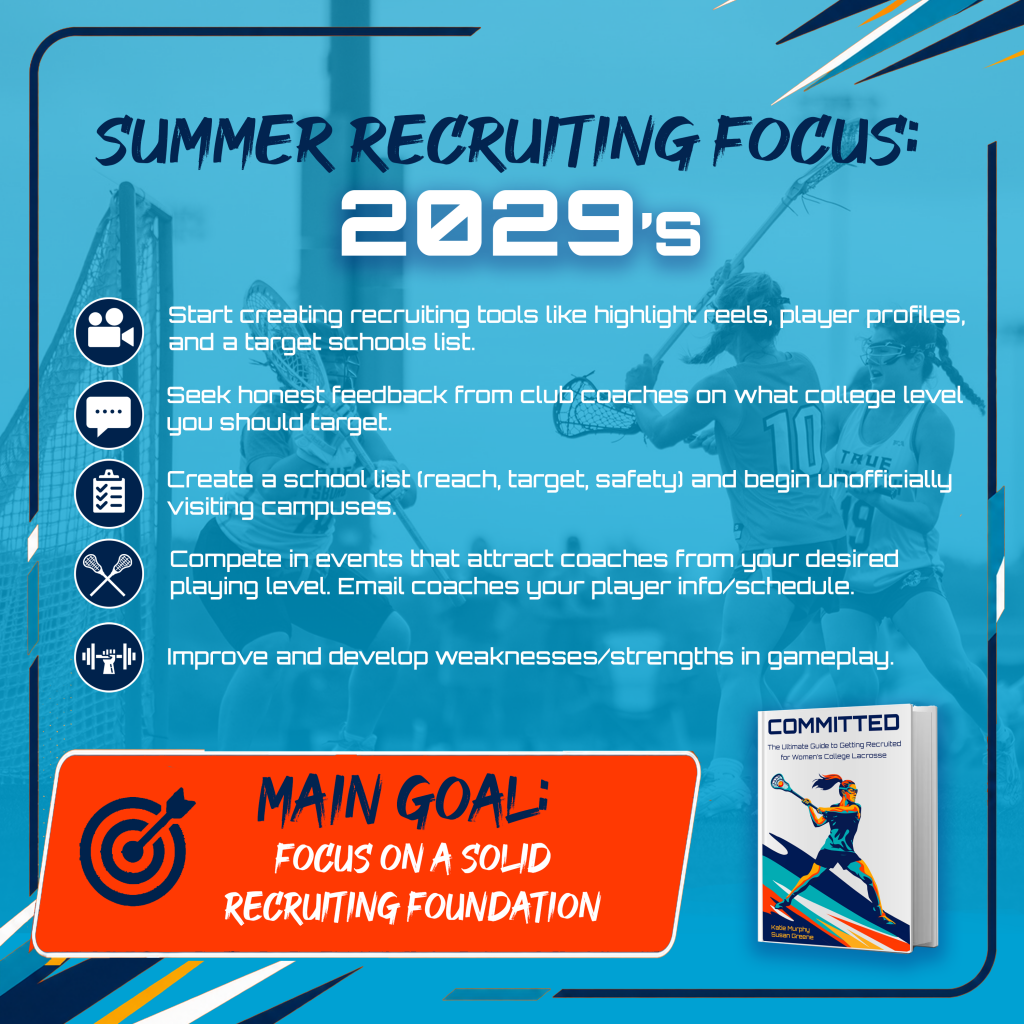
The checklist below highlights five steps 2029 lacrosse players should focus on now to begin moving in the right direction.
1. Start Building Your Recruiting Tools
As a rising sophomore, you should create your initial set of recruiting materials. College coaches may not be ready to communicate with you directly yet, depending on the division and recruiting rules, but they can still evaluate players at events, watch film, and begin tracking athletes who may become future recruits.
Your recruiting materials should include the following items:
- Highlight video
- Player profile
- Academic information
- Club team information
- Event schedule
- Contact information for your club or high school coach
Your player profile should be simple, clear, and easy for coaches to review. Include your name, graduation year, position, club team, jersey number, GPA if available, and any upcoming tournaments, camps, or showcases you plan to attend.
Your highlight video doesn’t need to be long. Coaches would rather see a few strong, recent clips than a video filled with average plays. Focus on moments that show your athleticism, stick skills, game IQ, decision-making, effort, and position-specific strengths.
For 2029 players, you don’t need to look like a fully-accomplished high school player. The goal is to make it easy for a coach to begin learning who you are and to keep watching your development.
2. Create a Target List of Schools
Now is a great time to begin building a list of colleges that may be a good fit academically, athletically, geographically, socially, and financially.
Your first list doesn’t need to be perfect. In fact, it should probably be broad. As you learn more about different schools and lacrosse programs, your list will change. That is part of the process.
Start by researching schools at different levels, including:
- NCAA Division I
- NCAA Division II
- NCAA Division III
- NAIA
- Club lacrosse programs
When researching schools, look beyond the lacrosse team. After all, lacrosse won’t be your chosen profession. College needs to prepare you for a career. Therefore, consider the full college experience when making your list. Ask questions such as:
- Does the school offer majors I may be interested in?
- Is the school well-respected in my chosen area of study?
- Is the size of the student population and campus appealing to me?
- Do I like the location – urban vs. rural, near vs. far from home, cold vs. hot climate?
- Does the school seem like a possible financial fit?
- Would I be excited to attend this college even if lacrosse were not part of the equation?
It can be tempting to build a list only around big-name programs and prestigious schools. But remember, the goal isn’t to impress your high school friends; it’s to find a college where you can be happy and successful as a student, athlete, teammate, and person.
3. Ask for Honest Feedback About Your College Level
One of the most valuable things a 2029 player can do is ask trusted coaches for honest feedback. This includes your club coach, high school coach, or anyone who has experience helping athletes through the recruiting process. You may even find that your summer club team has assistant coaches who currently play college lacrosse and can give you insights into what coaches expect at that level.
Ask where they think you currently fit as a college prospect and what level you should be targeting.
That conversation may include feedback about:
- Athleticism
- Stick skills
- Game IQ
- Speed and strength
- Position-specific ability
- Coachability
- Work ethic
- Academic profile
- Current level of play
- Areas that need improvement
Be open to hearing the truth. Honest feedback is not meant to discourage you. It is meant to help you make better decisions.
Not everyone is a DI recruit. Even if you’re a superstar on your high school team, that doesn’t mean you’re a shoe-in for a top college program. The competition is extremely high level at the college level.
If your coach believes you are currently tracking toward Division II, Division III, club, or NAIA, that feedback is incredibly useful. Don’t feel insulted. Instead, continue working on your skills – you’ve still got time – but also seek out non-DI schools that may be more realistic.
Once you understand where you may fit, you’ll find it easier to build a recruiting plan that makes sense.
4. Compete in Events That Match Your Goals
Tournaments, camps, showcases, and prospect days can all play a role in recruiting, but not every event is right for every player. Events can be costly, especially if they’re not in your local area and you have to pay for transportation and a hotel. As a rising sophomore, you should be thoughtful about where you spend your time and money.
Look for events that attract coaches from the types of schools you are interested in and the level where you may realistically compete.
Before registering for an event, ask:
- What college coaches usually attend?
- Are those schools on my target list?
- Do the programs match my academic and athletic level?
- Will I have a real opportunity to be evaluated?
- Is this event worth the travel, cost, and time commitment?
Once you know your schedule, email coaches from schools you are interested in. Your email should be short, organized, and specific.
Include:
- Your name, graduation year, position, club team, and jersey number
- Your event schedule, including field numbers and game times
- A link to your highlight video or player profile
- Your GPA or academic information if available
- Contact information for your club or high school coach
- A brief sentence about why you are interested in that school
At this stage, some coaches may not be able to respond directly because of recruiting rules. That doesn’t mean you’re wasting your time emailing them. Coaches can still read your information, watch your video, follow your schedule, and evaluate you at events, keeping you in mind as a potential future recruit.
5. Improve Your Strengths and Weaknesses
Recruiting tools, events and emails to coaches are important. But nothing matters more than your development as a player.
For 2029 lacrosse players, this is an important time to work on building your strengths and mitigating your weaknesses. No matter what level you get to, there will always be room for improvement. The better you get as a player, the more attractive you’ll be to college coaches. College coaches want players who are willing to work, learn, and grow.
Focus on improving areas such as:
- Stick skills with both hands
- Shooting accuracy and shot selection
- Dodging and change of direction
- Defensive footwork and body positioning
- Draw skills
- Goalie clears and communication
- Off-ball movement
- Transition play
- Field vision and decision-making
- Conditioning, speed, and strength
- Communication and leadership
Game IQ is especially important. Coaches want players who understand more than just their own role. They want athletes who can read the field, make smart decisions, adjust under pressure, and help their teammates succeed.
Watch college lacrosse. Study players in your position. Pay attention to movement, spacing, communication, pace, and decision-making. Then bring those lessons into your own practices and games.
To develop as a player, you must be intentional. Ask questions. Listen to feedback. Work on small details. Even 1% improvements can make a difference. Compete hard even when no coach is watching.
Build the Foundation Now
For 2029 lacrosse players, recruiting is about building a strong foundation of both your skills and your recruiting materials.
Of course the recruiting process will become more serious in the years ahead, but the habits you build now can make a big difference later. Players who are prepared, organized, and committed to development put themselves in the best position to be recruited by the colleges of their choice.