
By: Katie Murphy
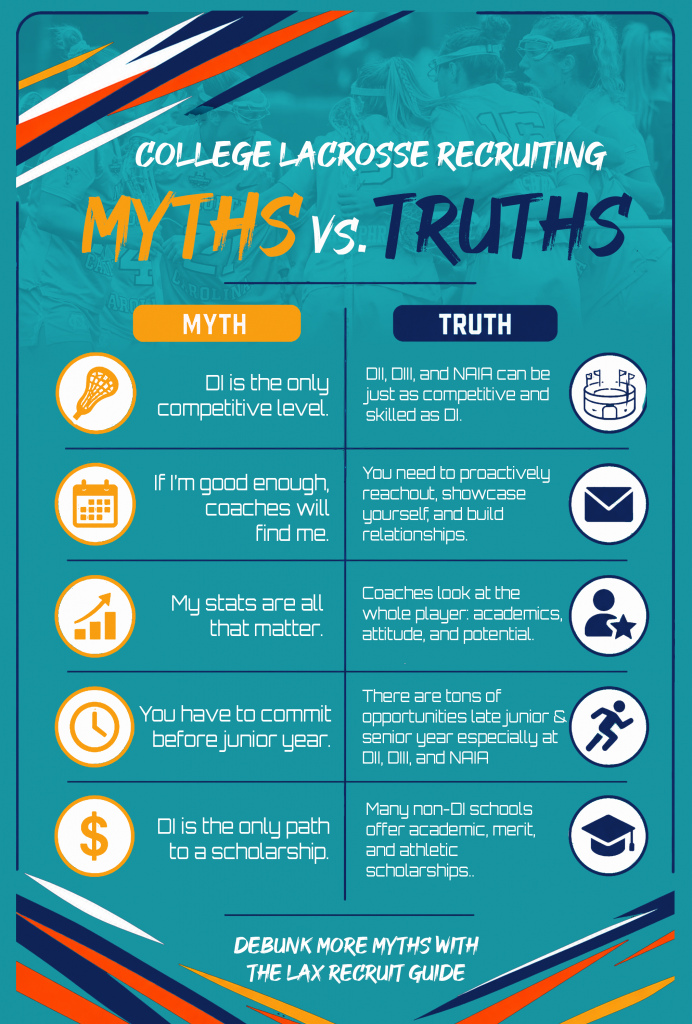
If you’re a high school girl lacrosse player dreaming about playing in college, you’ve probably heard a lot of recruiting advice.
Some of it is helpful.
Some of it is confusing.
And some of it? Totally wrong.
The recruiting process can feel overwhelming, especially when everyone seems to have an opinion. Your teammate says one thing. A parent on the sideline says another. Social media makes it look like everyone is committing early, going DI, and getting full-ride scholarships.
But here’s the truth: there is no one “right” path to playing college lacrosse.
Let’s break down five common recruiting myths that can hold players back — and talk about what’s actually true.
Myth #1: DI Is the Only Competitive Level
A lot of players think Division I is the only place where “real” college lacrosse happens. Not true.
Yes, DI lacrosse is competitive. But so are DII, DIII and NAIA programs. Many of those teams are packed with talented, skilled, hard-working athletes who could compete at a high level anywhere.
The pace is fast. The coaching is strong. The expectations are serious.
Choosing a college lacrosse program should not be about chasing a label. It should be about finding the right fit for you — athletically, academically, socially and financially.
You may find that your best opportunity to grow as a player, earn playing time and love your college experience is at a DII, DIII or NAIA school. And that is not “settling.” That is being smart.
Myth #2: If I’m Good Enough, College Coaches Will Find Me
This is one of the most common recruiting myths people believe.
You may be a strong player. You may start on your high school team. You may stand out at tournaments.
But college coaches are busy. They are watching hundreds, sometimes thousands, of athletes. They may never know who you are unless you put yourself in front of them. That means you need to be proactive.
Reach out to coaches. Send emails. Share your highlight video. Attend the right camps and showcases. Follow up. Keep coaches updated on your progress.
Recruiting is not just about being talented. It is about being visible.
You don’t need to be pushy. You don’t need to sound perfect. You just need to communicate clearly and consistently. Coaches want players who take ownership of the process. When you reach out, you show initiative, confidence and maturity. Those things matter.
Myth #3: My Stats Are All That Matter
Stats are important. Goals, assists, draw controls, saves, caused turnovers — those numbers can help coaches understand what you bring to the field.
But stats are not the whole story.
College coaches are looking at the complete player. They care about your academics. They notice your body language. They watch how you
respond after a mistake. They pay attention to how you interact with teammates, refs and coaches.
They want to know:
- Are you coachable
- Do you work hard?
- Are you a good teammate?
- Can you handle challenges?
- Do you have room to grow?
A player with great stats but a bad attitude may raise red flags. A player with solid skills, strong academics and a great work ethic may be very attractive to a coach. Your talent and skills may initially get a coach’s attention. But it’s often your character that earns you a roster spot.
Myth #4: You Have to Commit by Junior Year
It can feel like everyone is committing early.
You see the social media posts. You hear the announcements. You start wondering, “Am I already behind?”
Take a breath. You do not have to commit before junior year to play college lacrosse. There are still many opportunities late junior year and into senior year, especially at the DII, DIII and NAIA levels.
Some programs are still building their recruiting classes. Some coaches are
looking for specific positions. Some players who’ve committed change their minds, opening up roster spots.
There’s no reason to panic. Instead, stay active in the process. Keep contacting college coaches. Update your highlight video. Continue improving. Expand your target school list. Be open-minded about different divisions and programs.
Your timeline does not have to look like someone else’s timeline. A later commitment can still lead to an amazing college lacrosse experience.
Myth #5: DI Lacrosse is the Only Path to a Scholarship
Many players assume that if they want scholarship money, they have to play Division I. That is not the full picture
Yes, some D1 programs offer athletic scholarships. But many non-D1 schools also provide financial opportunities. Depending on the school, you may be able to receive academic scholarships, merit aid, athletic scholarships or other forms of financial support.
Sometimes the best financial package comes from a school you didn’t originally have on your radar. That’s why you should look beyond the division name and understand the full cost of attendance, scholarship options and financial aid opportunities.
Remember, if you graduate with college debt, you could spend the first 10 years or more of your post-graduation life paying back your loans. Be realistic about what decisions make the most financial sense.
The goal is not just to get recruited. It’s to find a school where you can play lacrosse, get a great education and graduate with limited debt.
The Truth About Girls Lacrosse Recruiting
Recruiting can be exciting, stressful, confusing and emotional — sometimes all in the same week.
But the more you understand the process, the more confident you become.
- You don’t have to chase only DI programs.
- You don’t have to wait for coaches to magically discover you.
- You don’t have to be defined by your stats.
- You don’t have to commit early to have options.
- You don’t have to assume scholarships only exist at one level.
There are many paths to college lacrosse. The right one is the path that fits you. Want to learn more about what is real — and what is not — in the recruiting process? We debunk even more myths in our book, Committed: The Ultimate Guide to Getting Recruited for Women’s College Lacrosse.